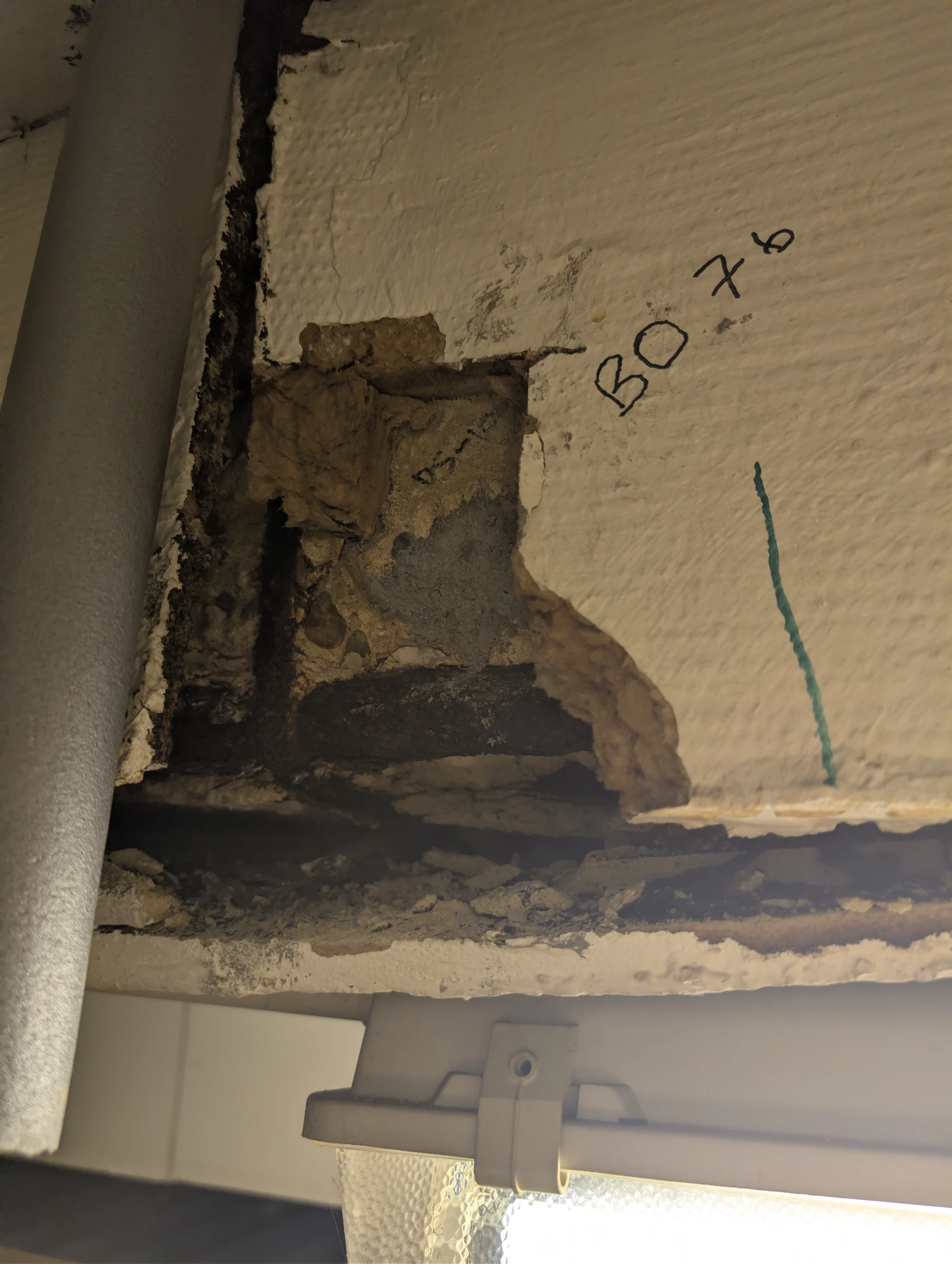
Every service below is available as a stand-alone commission or as part of a full remediation package, spanning reinforcement corrosion, chemical attack (chlorides, carbonation, ASR, sulphates) and post-fire assessment. Priced per element, per m² or per programme.
// SERVICE 01
Structural Diagnostics
Investigation & condition survey
Detailed visual, hammer-tap and instrument surveys to identify delamination, spalling and cover loss. We map every affected area and grade its severity before any works commence.
Hammer & sounding surveys
Cover meter & half-cell mapping
Photographic defect registers
// SERVICE 02
Concrete Chemistry & Testing
Establish the deterioration mechanism
Core sampling and on-site testing to identify the mechanism at play, chloride ingress, carbonation, sulphate attack, ASR, or a combination. Sampling and laboratory work is scoped to answer the specific diagnostic question, so the specification follows the fact, not a guess.
pH indicator carbonation depth testing
Chloride ion titration and profile analysis
Sulphate content and BRE SD1 ground-water assessment
Petrographic examination for ASR, ettringite and mix design
Cover meter, half-cell potential and resistivity surveys
// SERVICE 03
Reinforcement Corrosion Repair
Break out · clean · treat · reinstate
Concrete broken out to a minimum of 25 mm behind the bar. Rebar cleaned to SA 2½, treated with a zinc-rich passivating primer, then reinstated with a compliant repair mortar or micro-concrete.
Selective breakout with hydro/mechanical means
Grit-blast cleaning to SA 2½
EN 1504-3 R3/R4 repair mortars
// SERVICE 04
Concrete Spall & Patch Repair
Reinstatement to profile
From isolated soffit patches to running façade spalls, we form, prime and rebuild in appropriate repair concrete, feathered and finished to match the substrate.
Feathered edge & saw-cut perimeters
Fibre-reinforced repair mortars
Anti-carbonation coating options
// SERVICE 05
Cathodic Protection (Advisory)
Long-term corrosion control
Where chloride contamination is extensive, we advise on galvanic anode and impressed-current systems, working with specialist installers to protect the whole element long-term.
Galvanic sacrificial anodes
Anode spacing & load calculations
Cover-zone remediation
// SERVICE 06
Structural Assessment & Reporting
Reports contractors & engineers can use
Structured reports with plans, defect registers, photographs, laboratory data and a costed repair schedule. Written to be read by consulting engineers, insurers and asset owners.
EN 1504 compliant methodology
Costed scope of works
Digital defect registers
// SERVICE 07
Crack Injection
Sealing structural and non-structural cracks
Injection of low-viscosity epoxy or polyurethane resins into cracks to restore monolithic behaviour, block water ingress and prevent further deterioration. Product and viscosity chosen to match crack width, movement and environment.
Low-viscosity epoxy for structural, non-moving cracks (Nitofill LV)
Flexible PU resin for wet or actively-leaking cracks (Nitofill TH)
Port-and-seal method, pressure-injected to full depth
// SERVICE 08
Crack Stitching & Helical Reinforcement
Restraining movement across cracks
Stainless-steel helical bars bonded into slots cut across a crack to restrain further movement and restore tensile capacity. Common on masonry-clad concrete, façades and structural walls where injection alone isn't sufficient.
Helifix HeliBar stainless steel helical bars
Helifix HeliBond cementitious grout
Discrete, low-disruption install — no wide-scale demolition
// SERVICE 09
Protective Coatings
Anti-carbonation, chloride-resistant & elastic systems
Whole-element coatings applied after repair to extend service life. Specification matched to the deterioration mechanism: anti-carbonation for CO₂ ingress, chloride-resistant for coastal / de-icing salt exposure, or elastomeric to bridge dynamic cracking.
Dekguard S anti-carbonation coating (EN 1504-2)
Dekguard S200 chloride & water resistant coating
Dekguard Elastic crack-bridging coating for façades
// Method statement
Every repair is executed to EN 1504.
The European standard for concrete repair isn't a suggestion, it's the yardstick a defensible repair is measured against. We work to it as a minimum on every project.
We use essential cookies to make the site work, and optional analytics and advertising cookies to measure how it's used. You can accept all, reject non-essential, or choose which to allow. See our Cookie Policy.