
// What it is
Concrete cancer, an internal chemistry problem
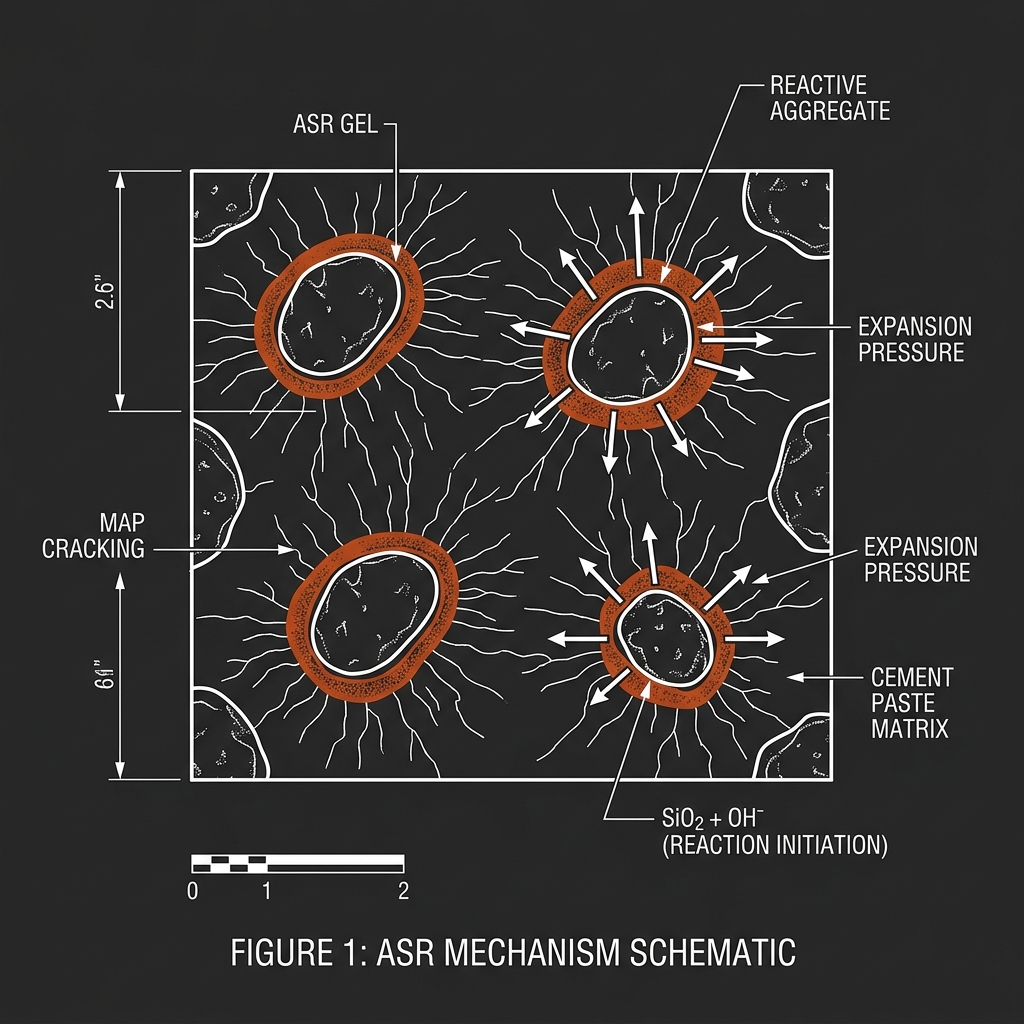
Certain silica-bearing aggregates react with alkalis in the cement paste, forming a hygroscopic gel. The gel absorbs moisture, expands, and generates internal tensile stresses well in excess of the concrete's tensile strength, producing characteristic map cracking, expansion and long-term loss of durability.
// Causes
Where it comes from
- 01Reactive aggregates (opal, cristobalite, strained quartz, some cherts)
- 02High-alkali cement or alkali-releasing exposure
- 03Persistent moisture (structure needs water to sustain the reaction)
- 04Older UK concrete where reactive aggregate sources were not screened
// Symptoms
What you might see on site
- 'Map' cracking (a random polygonal pattern) on exposed surfaces
- Gel exudation from cracks (translucent, brown-tinted)
- Expansion of the element, closing joints or bowing
- Pop-outs over individual reactive aggregate particles
// Diagnosis
How we investigate
- T · 01Petrographic examination of cores under polarised-light microscopy to identify reactive aggregate and gel
- T · 02Expansion monitoring, pip gauges, DEMEC studs over months
- T · 03Moisture content monitoring (ASR requires ~80% internal RH)
- T · 04Structural review of load paths given loss of tensile capacity
// Repair
How we put it right
ASR is a bulk chemistry problem, it cannot simply be patched out. Strategy focuses on removing moisture ingress (waterproofing, drainage), monitoring expansion, restraining the element where necessary, and in advanced cases replacing affected sections. Surface treatments to reduce moisture (silane impregnation) are commonly specified as part of the mitigation package.

