
Post-fire structural assessment & repair
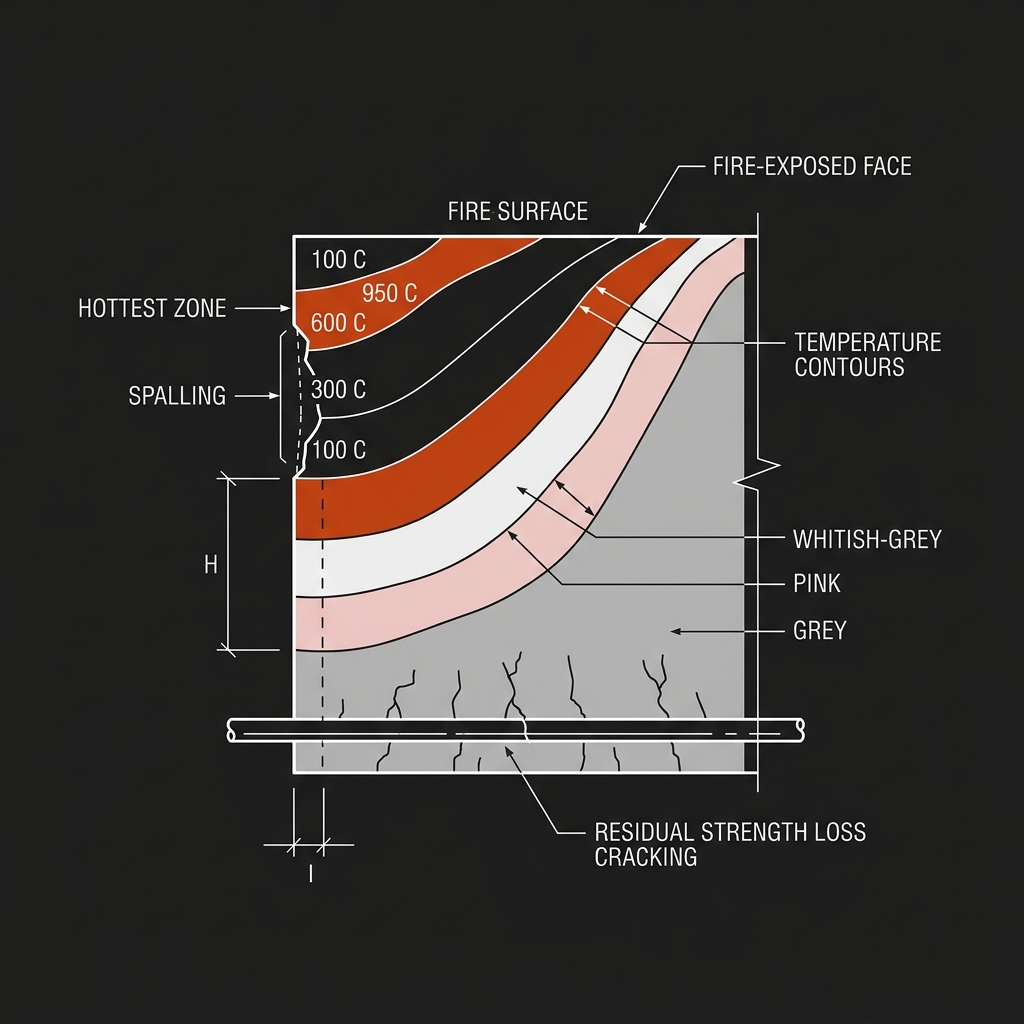
Above ~300 °C the calcium hydroxide in hardened concrete begins to break down; above ~500 °C compressive strength is significantly and permanently reduced; and reinforcement loses yield strength that only partially recovers on cooling. A methodical post-fire assessment is essential before an element can be recommissioned.
Where it comes from
- 01Building fires, office, residential, industrial
- 02Vehicle fires in car parks
- 03Industrial and process fires
- 04Deliberate acts
What you might see on site
- Colour change (pink 300 to 600 °C, whitish-grey 600 to 950 °C) indicating temperature reached
- Spalling, explosive or progressive, exposing reinforcement
- Cracking, particularly along reinforcement lines
- Sooting, softening of surfaces, loss of section
How we investigate
- T · 01Post-fire visual and colour survey to estimate temperature contours
- T · 02Ultrasonic pulse velocity to assess depth of damaged concrete
- T · 03Core sampling for residual compressive strength
- T · 04Cover surveys and reinforcement testing where accessible
How we put it right
Damaged concrete is broken out to sound material, often to a considerable depth. Reinforcement is inspected and, where yield strength is compromised, supplemented or replaced. The element is reinstated in a repair mortar appropriate to the load duty. Where structural capacity is materially reduced, strengthening (plate bonding, FRP wrap or additional bars) is designed in as part of the reinstatement.
Recommended Fosroc products

High-strength, fibre-reinforced hand-applied repair mortar

Single-component zinc-rich epoxy primer for exposed reinforcement

High-strength epoxy repair for severe or thin-section reinstatement